Every project, the same scene. A new customer signs, the scope is agreed, and somewhere in the plan sit two lines: “acceptance testing tool” and “data migration”. And every time, one of the strongest engineers on the team opens an empty folder and starts writing them. Again.
Not because the old ones were lost. Because the last customer was “a bit different”, the old script lives on someone’s laptop, and starting fresh feels faster than finding out what already exists. (It almost never is.)
I think this is the most expensive habit a professional services team can have. Not the big failed project. The small, banal, repeated work that quietly eats your best people.
Not all services work is the same
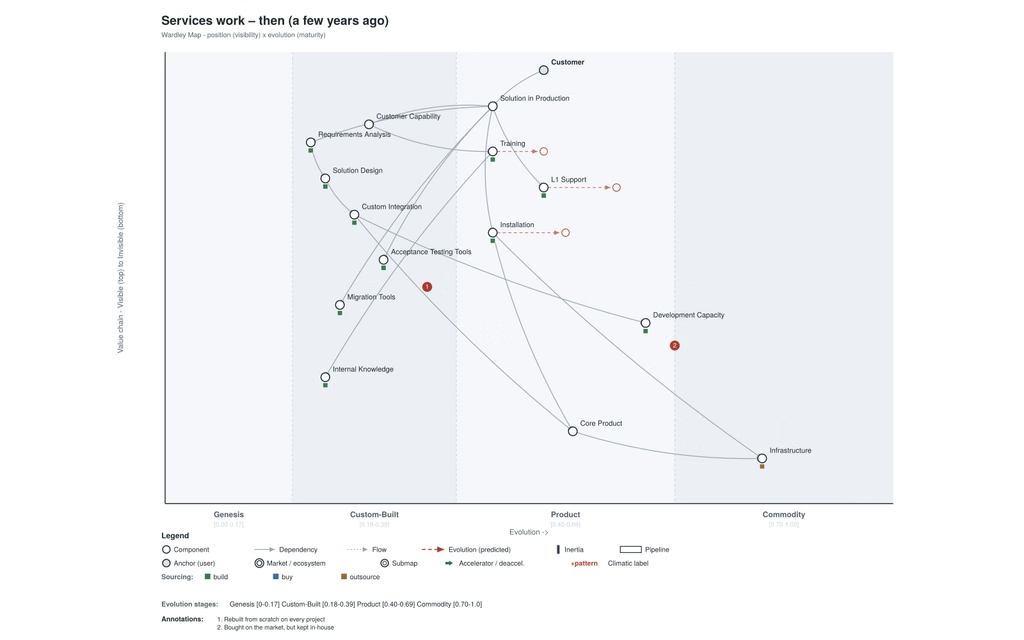
Start with the customer. They don’t need an installation or a training. They need the solution running in production and actually used by their people. Everything a services team does sits below that need:
- analysis with the customer: scope, specs, what to build
- solution design
- custom integration with their systems
- acceptance testing
- data migration
- installation and configuration
- training
- first-line (L1) support
- extra development capacity when a project peaks
A Wardley map puts these on two axes. Vertically: how visible each one is to the customer. Horizontally: how evolved it is, from genesis (new and uncertain), through custom-built and product, to commodity (standard, boring, everywhere).
The trap is treating all of it as one kind of work. Same people, same method, same “we do it ourselves”. But analysis and solution design for a new customer really are new every time. A standard installation is not. Acceptance testing and migration sit in between: every project has them, the pattern repeats, only the details change.
Simon Wardley’s doctrine has a blunt rule for this: use appropriate methods [1][2]. Uncertain, custom work needs experts and agile ways of working. Things in the middle need lean: cut waste, make it repeatable. Commodity needs industrial methods that reduce variation, and you buy it as a service. The same goes for purchasing. No single method fits, because every real system has components at different stages at the same time.
What has already moved
A few years ago, nearly all of this was done by the vendor’s own people, by hand, per project. Today, several components have moved right on the map:
- Development peaks go to external developers. Extra capacity is a market you buy from, not a team you must build.
- Installation is starting to move to partners. Big vendors went this way long ago: Salesforce says 70 percent of its implementations are led by credentialed experts in its partner ecosystem [3].
- First-line support is starting to use AI for routine questions.
- Training moved to a self-service portal, with AI on top for questions. But the portal is only as good as what’s behind it: internal knowledge and shared tooling that are still custom-built and live in people’s heads.
Deloitte sees the same direction across software vendors: their own services shift toward adoption and advice, while partners supply implementation capacity [4].
So the landscape is moving. The question is why the banal work in the middle, acceptance testing and migration, is still built from scratch.
Two kinds of inertia
Wardley calls the resistance inertia. It isn’t a sign of stupidity. It usually comes from past success.
Ours is easy to name. Building it yourself feels safe. Billable days look good on the project margin. “Nobody knows our product like we do” is even true. And the engineer who wrote the last migration script is proud of it, so the next one gets written by the same proud engineer, from scratch, “properly this time”.
TSIA’s State of Professional Services 2025 says the same about the whole industry: the change is coming, but slower than expected, because inertia is strong [5].
The second kind surprised me more. Customers resist too. You give them a self-service portal, ready tooling, documentation – and they can’t use it. Not won’t. Can’t. They lack the people, the skills or the time. Wardley describes this consumer-side inertia too: the disruption of how things worked before, and the cost of the transition, including acquiring new skills [6].
On a map, that means the customer’s own capability is a component. A self-service portal only works as a commodity if the user can consume it. If they can’t, the work quietly comes back to your senior engineers. Usually as an urgent call.
Partners have the same catch. A TSIA survey found that only 49 percent of professional services organizations have a documented way for partners to reach their experts [7]. Outsourcing doesn’t remove the work of enabling others. It changes who you enable.
Who turns one-off work into a tool?
Wardley describes three attitudes [8]. Pioneers explore the new. Settlers turn it into something repeatable that others can use. Town planners industrialize it at scale. Pioneers and town planners get the attention. Settlers are often missing.
That’s exactly the gap with acceptance testing and migration. The first version was pioneering work. Somebody should have turned it into a maintained tool. Nobody owned that step, so every project starts over.
Today, in most services teams I know, the three attitudes are mingled. The same engineer pioneers a new integration in the morning and reruns a standard install in the afternoon. Nobody is anybody’s settler, so nothing gets turned into a tool.
A fair warning from Matt Edgar, who worked at the UK Government Digital Service: don’t restructure your whole organization into these three tribes [9]. I agree with the spirit. You don’t need a big reorg. You need to separate the work: pioneers on analysis and new integrations, a small team of settlers turning one-offs into tools, and town planners running the standard services with partners and AI.
AI: accelerator and duplication machine
AI helps here. A lot. Debugging is faster. Writing or changing a tool takes hours instead of days. That should make it easy to move acceptance testing and migration tooling from custom to product.
But there’s a flip side. When building a tool is cheap, everyone builds their own. Nobody checks whether the tool already exists, because generating a new one is quicker than searching. You end up with five migration tools, each slightly different, none of them maintained.
This isn’t just my impression. GitClear found that duplicated code blocks rose about eightfold during 2024 as AI assistants spread (vendor research, but it matches what I see), and Google’s DORA report linked more AI use with lower delivery stability [10].
Wardley’s doctrine has a rule for this too: remove bias and duplication [1]. People rebuild what exists because of inertia and because they don’t know it exists [11]. AI makes duplication cheaper. It makes the settler more important, not less. The fix isn’t banning AI. It’s making the shared tool easier to find and use than generating a new one.

The bottleneck moves up
There’s a second effect, and it’s the good one. When building gets cheap, building stops being the bottleneck. On more and more projects, writing the software isn’t what slows us down. Knowing what to write is: the scope, the specs, the analysis with the customer.
Wardley has a climatic pattern for this: efficiency enables innovation [12]. When a component becomes cheap and standard, people build new, higher-order things on top of it. Here the higher-order thing is better analysis. Free your best people from banal work and they can sit with the customer, work out what should be built, and let agents build much of it.
That changes the sourcing too. External developers used to be the buffer for every peak. Now we need fewer of them, because development capacity is rarely the constraint. Scope and specs are.

What I’d do
- Keep the novel work in-house with your strongest people: analysis with the customer, solution design and genuinely new integration. That’s where the bottleneck is now. A small team, agile methods.
- Give the repeated work to a small platform team. In Team Topologies terms, a platform team builds internal services that make delivery teams faster and removes complexity for them [13]. It runs them like a product: an owner, a backlog, versions, one place to find them. Start with the thinnest viable platform [14]: the acceptance testing and migration tooling, plus a simple list of what already exists. And one rule for everyone, with or without AI: look for the existing tool before you build a new one.
- Hand the commodity out – installs to partners, routine L1 to AI, basic training to self-service, the remaining development peaks to external developers – and invest in the customer’s ability to use what you hand over. Otherwise it comes back.
A caution: these placements are mine, for one kind of team at one point in time. Another company, another product, or the same team in two years would place things differently. A map is something to argue about and revisit, not a verdict.
Your best people should be solving problems nobody has solved yet. Not the same problem for the fifth time.
Sources
- Simon Wardley, “Doctrine”, Wardley Maps (ch. 4)
- “No One Size Fits All”, Wardley Maps book passage
- Salesforce, “The Salesforce Business Partner Ecosystem” (IDC data)
- Deloitte, “Evolving role of professional services in software companies”
- TSIA, “The State of Professional Services 2025”
- Simon Wardley, “I wasn’t expecting that”, Wardley Maps (ch. 10, consumer inertia)
- TSIA, “Partner Enablement: Funding, Tailoring, and Training Strategies”
- Simon Wardley, “Designing for constant evolution”, Wardley Maps
- Matt Edgar, “What do Wardley maps really map? A settler writes”
- LeadDev, “How AI-generated code accelerates technical debt” (GitClear 2025 study; Google DORA 2024)
- Wardley Community, “Remove Bias and Duplication” (adapted from Simon Wardley, CC BY-SA)
- Simon Wardley, “Exploring the map”, Wardley Maps (ch. 3)
- Team Topologies, “Key Concepts” (Matthew Skelton & Manuel Pais)
- Team Topologies, “What is a Thinnest Viable Platform (TVP)?”