A customer is stuck. Something doesn’t work, a deadline is close, and they need to get unblocked. That need has not changed since my first ticket as an L1 engineer. I’ve seen it since from many chairs: L1, L2 and L3 support, running support at a managed service provider for many end customers, and running support alongside project delivery at a software company that serves businesses and government.
People expect those worlds to be very different. They are less different than you’d think. The parts are the same, the forces acting on them are the same, and what changes over time is mostly how evolved each part is. That is exactly what a Wardley map is good at showing.
The same value chain everywhere
Strip any support setup down and you find the same chain. At the top is a customer with a need: get unblocked. Below that:
- intake channels: email, phone, a portal, chat or whatever else the customer uses
- tracking, so nothing gets lost and someone owns each issue
- remote access, to see and fix the problem
- knowledge: what we know about the product, past issues and this customer
- escalation, both from the customer to us and from us to whoever can fix the root cause
- KPIs and SLAs, which tell everyone what “good” means
What shapes a support operation is not whether it is an MSP or a software company. It is what the customer needs. One customer wants a phone line, another wants everything through a portal, a third needs 24/7 coverage. Even 24/7 comes in two flavors: an on-call engineer who picks up at night, or a staffed line that is always open. Underneath, the guts are the same: the same kinds of tools, the same chain. What differs is the workflow on top, and those workflows keep changing and evolving.
How each part moved
Wardley’s most basic climatic pattern is that everything evolves through supply and demand competition. Providers compete to make things better and cheaper, more people use and understand them, and components drift from the left of the map (new, custom, poorly understood) to the right (standard products, then commodity and utility). You can’t stop it, but you can see it coming.
That pressure is mostly good. Optimizing support, doing more with fewer people and less money, is what lets a team grow without drowning. It can also go too far. When Gartner surveyed nearly 5,800 customers at the end of 2023, almost two-thirds said they’d rather companies didn’t use AI in customer service at all, and the top worry was that it would get harder to reach a human. Klarna learned this in public: in 2024 it said its AI assistant handled most of its customer chats, and in 2025 its CEO admitted the result was lower quality and started hiring human agents again. Cheaper is not the same as better.
My own support history is a fairly clean illustration of the pattern.
Tracking. When I started, tickets lived in a CRM, and next to it hung a physical kanban whiteboard. We kept the two in sync by hand. It worked, but it was glue we built ourselves around tools that were never meant for support. Today PSA platforms do the same job from intake to resolution, with time tracking, contracts and reporting included. What we glued together, we now buy. Custom-built became product.
Remote access. We used an in-house VNC tool, and we drove to customers a lot, because their internet was too slow for anything else. Today remote access is a bought tool you barely think about, and bandwidth is a utility. Building our own was understandable at the time. Continuing to build it once products existed was wasted effort.
Escalation from the customer. When a customer is unhappy with how long something takes, or with the quality of the answer, they escalate. In a small company that meant calling the owner. Later it became a request to a supervisor. Today it can be a single “escalate” button in the portal. Better still, nobody has to press it: dashboards track how long tickets have been open and how customers rate answers, so a team lead can step in before the customer gets angry. Escalation moved from personal and reactive to built into the product and proactive.
Escalation by support. The other direction is support escalating to the next level, another department or another company. With external vendors like Microsoft or Adobe, it was always a ticket in their system, their priorities and their process. Escalation to your own engineers, in a small company, meant a quick meeting with people you knew. As the company grows, that starts to look like the vendor case: engineering becomes a separate department with its own backlog, and you file tickets and argue for priority. Done well, it ends in a fully traceable chain from the customer’s ticket to the bug or feature, with SLAs and resolution times. The practice evolved from custom (whoever you can catch) to product (a defined, measurable interface). Activities and the practices around them evolve together; better tools without a better way of working buy you very little.
KPIs and SLAs. These barely moved. Response and resolution times, first-contact resolution and customer satisfaction looked much the same everywhere I worked; only the kind of metrics and the agreements behind them changed. One warning holds everywhere, though. Set a metric as a hard target without balancing it against others, and people will optimize the number instead of the service. Goodhart’s law puts it simply: when a measure becomes a target, it stops being a good measure. Contact centers know the pattern well, for example agents transferring calls just to hit handle-time targets. Tread lightly.
Knowledge. This part stayed custom the longest. It lived in people’s heads, in old tickets and in that one colleague everybody called. Documentation was in even worse shape. It barely existed: scattered notes, nothing anyone maintained. It improved slowly, a little with each engineering team that cared about it. With AI, knowledge is now moving fastest, more on that below. There is a catch, though. Some customers allow neither remote access nor AI on their data, so the engineer has to know the system without any help. Aviation dealt with this long ago. Pilots fly on autopilot most of the time, and the US aviation regulator has warned that relying on automation erodes manual flying skills; it tells airlines to keep pilots practicing by hand. Support needs the same: training, outage drills and regular practice for the moments when the tools aren’t allowed or aren’t working.
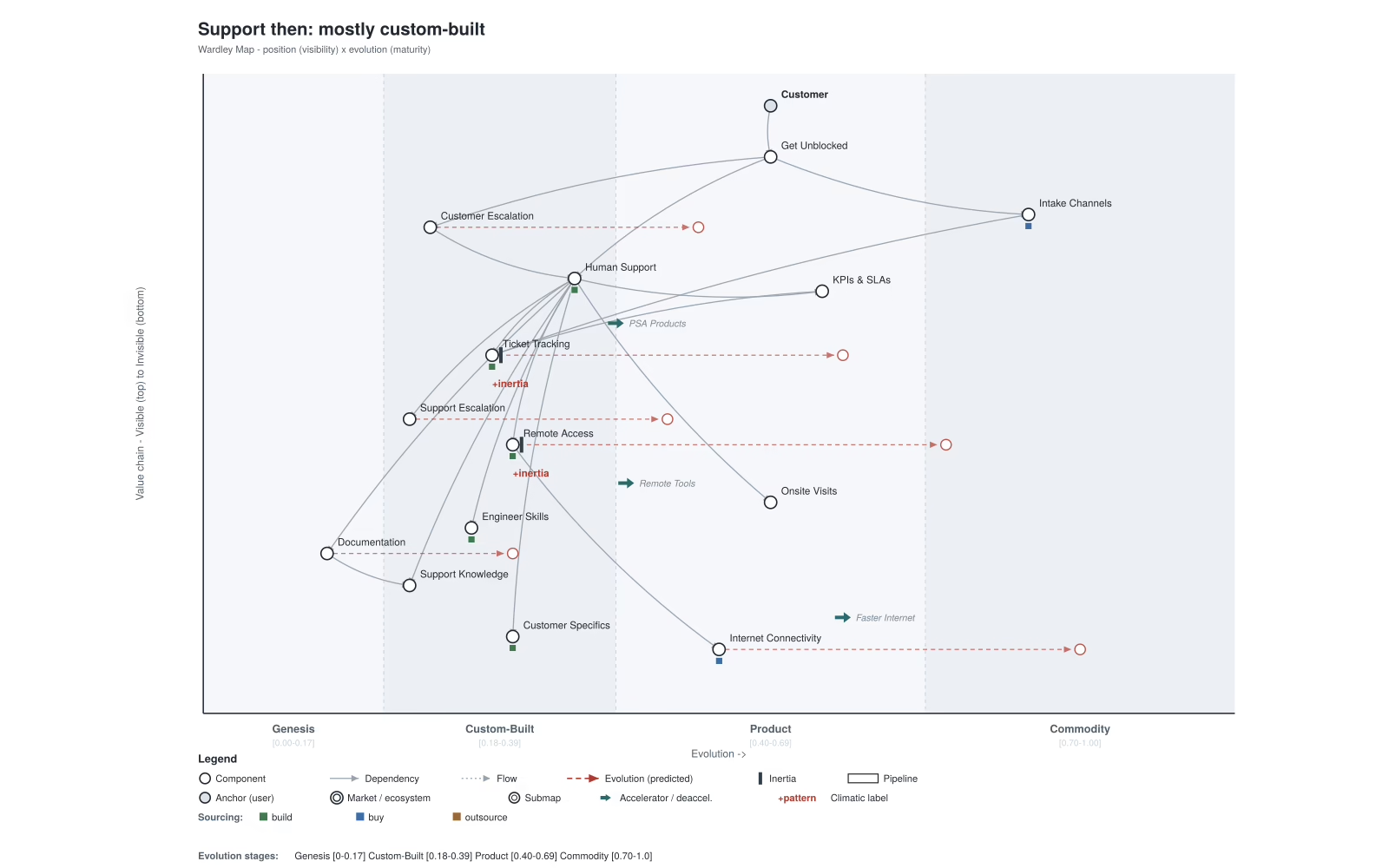
The first map is worth a closer look, because the direction of change was already visible back then. Internet speeds were improving. Remote-access and PSA products were appearing and getting better. The only thing holding our setup in place was ourselves: we had built those tools, we were used to them, and replacing them felt like admitting the effort had been wasted. Wardley calls this inertia, and his point is that past success breeds it. The things that once worked well for you are exactly the things you defend too long.
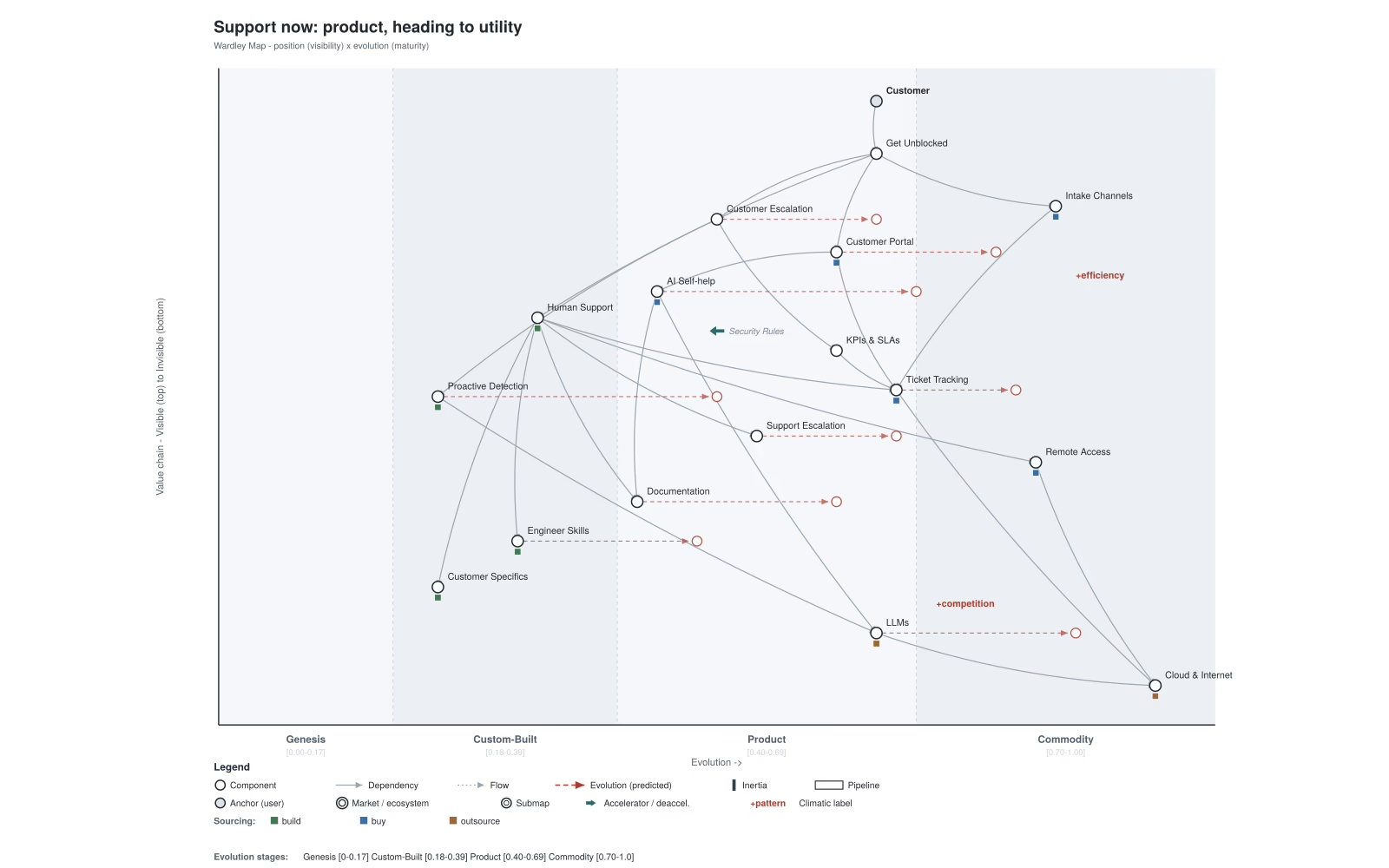
The arrows on the second map show where support is heading:
- Portals with AI self-help become a standard feature.
- Escalation in both directions becomes a built-in, measured flow.
- Problems get spotted before the customer reports them.
- Training engineers to work without their tools becomes normal practice rather than an afterthought.
One caution about both maps. Where each part sits is not universal. The same component can be custom-built in one company and a bought product in another, or move at a different speed in two teams of the same company. My placements reflect what I saw; yours will differ. A map isn’t a verdict. It’s a hypothesis you revisit as things change, and the useful habit is to keep adjusting it and exploring what the next move could be.
What stays custom
Not everything should move right, and not every brake is bad. Some components stay custom for good reasons:
- Product knowledge. Knowledge of your own product, especially the unusual cases, is unique by definition.
- Each customer’s specifics. Their environment, configuration, integrations and history differ from customer to customer.
- The escalation link. The link to whoever fixes the root cause, internal or external, is where support earns its keep.
The brakes come in two kinds. Some are legitimate: contracts that define the response model, and security and data rules that forbid remote access or AI, especially in government work. Others are just comfortable: habit, KPIs nobody has revisited, and “we built it, so we keep it”. A map helps you tell them apart, because legitimate brakes show up as real constraints in the value chain, while comfortable ones are attached to things the market already sells.
Where AI fits
AI is the latest force pushing support to the right, and it follows the same pattern as everything before it. Models are becoming a utility, and assistants built on them are becoming standard features of support tools. Several things follow.
First, many issues never become tickets. When a user can get a good answer immediately, the problem is solved before anyone in support sees it.
Second, a proper customer portal becomes far more powerful. Self-help used to be weak: Gartner found in 2024 that only 14% of issues were fully resolved in self-service, most often because customers couldn’t find content that matched their problem. With AI on top of good documentation, self-help can actually resolve things, and you can measure it with the same KPIs and SLAs as the rest of support.
Third, there is a trap. Making customers talk to a chatbot must not become the goal. What people value is the option to reach a real person when they want to, and Klarna’s CEO ended up promising exactly that. A good support model treats that option as part of the service, not as a failure of automation.
Fourth, and my favorite, documentation suddenly matters to everyone. For years people would not document things for their colleagues. Now the same people happily document for an AI, because they can see it working. AI also helps write and maintain that documentation, which removes much of the old excuse.
None of this changes the fundamentals. The customer still needs to get unblocked. Hard problems still go to people who know the product. Knowing the customer still matters most. AI moves the routine part from product toward utility, just as tracking and remote access moved before it.
Lessons
Don’t build what the market already sells. Looking back, building our own VNC tool and our own customer portal at a small company was wasted effort. Once a product category exists, the energy is better spent elsewhere.
Invest in what stays custom, and keep people sharp. That means product knowledge, each customer’s specifics, a clean escalation link in both directions, and the skills your engineers need when automation isn’t allowed or doesn’t work.
Name the inertia, and don’t overshoot. Keep the brakes that protect customers, such as contracts and security. Release the ones that only protect habits. And don’t confuse cheaper with better: the goal is getting customers unblocked, not keeping them away from people.
Sources
- Simon Wardley, “Exploring the map”, Chapter 3 of Wardley Maps
- Gartner (2024), Survey finds 64% of customers would prefer that companies didn’t use AI for customer service
- CRM Magazine (2024), Only 14% of customer service issues are fully resolved in self-service (Gartner study)
- Entrepreneur (2025), Klarna is hiring customer service agents after AI couldn’t cut it on calls
- FAA, SAFO 13002: Manual Flight Operations
- Call Centre Helper, The real reason your agents are cheating to hit targets (Goodhart’s law in contact centers)